

By Jack W Erter MD, MMHC (Hematologist/Oncologist Expert Witness)
Recently, I worked on a case that was centered on a patient developing a debilitating side effect from an anti-cancer treatment. The patient developed a very severe form of a well-known, but usually much less severe, side effect of a widely prescribed medication and sadly spent a good deal of the rest of their life in and out of the hospital related to this. (Additionally, there was question as to whether the medication was appropriately deployed in the first place.) Ironically, I wasn’t questioning whether the physician recommended the right drug first. I was asking a different question: Can I tell from this chart what conversation actually took place?
Can I tell from this chart what conversation actually took place?
-Jack W. Erter, MD Hematologist/Oncologist
On review of the material in this case, the consent process was documented via a somewhat boilerplate note signed by the patient and nursing staff, as well as somewhat vaguely in the physician’s progress note. The exact same language was then copied and pasted in each subsequent progress note, which stretched credulity as to whether the patient was truly consented at each visit (or even in the first place).
In this case, the issue of whether the patient truly went through the informed consent process was an important issue. Was the patient truly aware of this potential side effect that could develop? Did they know how severe it could be? How do we know that they understood what they were agreeing to? The deposition of a family member of the patient certainly called into question whether the patient had a full understanding of the potential toxicities of the treatment they were on, creating huge legal issues for a likely well-intentioned physician simply due to a lack of a clearly documented consent process.
I am a practicing hematologist/oncologist with patients on a wide variety of therapies with varying degrees of risks that require informed consent. Informed consent oncology cases present unique challenges precisely because so much depends on how, not just whether, that conversation was documented. As an expert witness, looking at informed consent through the lens of its application legally has been fascinating (and caused me to rethink and refocus on how I utilize and document informed consent myself). Within the scope of my practice, I have seen firsthand side effects ranging from minor irritations to very serious, emergent issues. Having clear documentation that such risks were discussed prior to starting any therapy has been paramount to my conscientious treatment of patients.
What is informed consent?
The American Medical Association (AMA) defines informed consent as an ongoing communication process where a physician presents medical facts and the patient authorizes a specific treatment. It respects the patient’s right to self-governance and ensures they are free from manipulation. That said, informed consent is more than obtaining a signature. It is an ongoing discussion that documents the diagnosis, treatment options, material risks, benefits, alternatives, and the patient’s decision. Informed consent oncology cases presents unique consent challenges because many therapies intentionally carry substantial toxicity. Patients are often weighing potentially life-saving treatment against serious or permanent side effects. That makes documenting the discussion especially important.
Where does informed consent become a medical legal issue?
A patient may bring a lawsuit against a healthcare provider based solely on the allegation that he/she did not give consent or go through an informed consent process at all. Examples would be a surgeon extending an operation beyond what the patient agreed to, or operating on a different part of the body than what the patient consented to have treated. Within oncology, this could include giving a medication or treatment with potential adverse side effects without any consent process whatsoever.
A much more common claim is that the informed consent process did not include proper, complete, or adequate information. This is a “lack of informed consent” claim. Again, thinking about the consent process from the lens of hematology/oncology, this could include, for instance, a patient developing severe neuropathy or nerve pain from a specific treatment and later claiming that this risk was never discussed as part of the informed consent process.
Four Things I Look for During Record Review
- Was there evidence of an actual discussion?
- Did the documentation match the treatment?
- Was the discussion individualized?
- Did the chart show the patient’s decision-making?
Unique Aspects of Informed Consent in Hematology/Oncology
In my role as a hematologist/oncologist, a few unique aspects of informed consent are worth some focus.
Weighing Benefit Against Toxicity
As discussed above, we are constantly having to weigh the potential benefit of a treatment against quite severe toxicities. That benefit can often be difficult to accurately convey, such as explaining that a treatment may extend progression-free survival (the time before the cancer worsens) rather than promising a cure. When reviewing a case, attorneys should look closely at how that benefit was actually explained to the patient, not just whether a consent form was signed.
Routine Treatments Still Carry Real Risk
We give very routine treatments for routine, non-cancerous conditions, such as iron deficiency anemia, multiple times a day every day. While rare, serious infusion reactions do happen, and if you are prescribing treatments frequently enough, you will have a patient at some point have a reaction. Documenting that this was explicitly discussed is paramount, especially because the treatment was not “life-saving,” in the way that chemotherapy might be. For attorneys, this is a key distinction: the more routine or “low-stakes” a treatment appears, the more a thin consent record can become a liability issue, since there’s no obvious justification for skipping the conversation.
Complications That Parallel the Cancer Treatment Itself
Issues parallel to oncology treatment itself often arise and need to be carefully documented and assessed. A clear example is that cancer treatment, including chemotherapy, weakens the immune system and makes patients much more likely to experience serious infections. I worked on a case involving a catastrophic outcome after a stem cell transplantation, where the nuance of how informed consent around infection risk was documented became central to the case. Attorneys evaluating similar cases should ask whether the record shows the immune-suppression risk was addressed as its own conversation, not folded silently into general treatment consent.
End-of-Life and Treatment De-Escalation Decisions
We also need to carefully document discussions around end-of-life treatment decisions, including when we decide to stop active treatment or “de-escalate care.” In these conversations, patients and families are often weighing the limited benefit of toxic cancer treatments against the uncertainty of extra life expectancy or improved quality of life, as opposed to shifting to supportive care alone. While uncommon, it’s important that patients and families never feel they were deprived of appropriate care. For attorneys, this is often where claims arise later, a family member asserting they weren’t told treatment was being stopped or scaled back. Documentation of how that conversation happened, not just that it happened, is often what determines whether a claim holds up.
Attorney Screening Informed Consent Questions
- Does the consent documentation appear individualized or copied?
- Even worse — is it copied over and over in progress note after progress note?
- Were the risks that occurred actually discussed beforehand?
- Does the physician note support the signed consent form?
- Was informed refusal documented if treatment was declined?
- Especially involving family members, as a patient in this situation may be quite dependent on their loved ones at that point.
- Would another physician understand exactly what conversation took place?
The case that opened this piece was never really about which drug was chosen. It was about whether the chart could answer a simple question: what did this patient actually understand before they said yes? That is the question every informed consent oncology case (or any informed consent case) ultimately comes down to, and it is the question attorneys should be asking from the very first record review.
Attorneys:
Need a hematology/oncology expert who can speak clearly to both the medicine and the documentation? Contact Dr. Erter directly, or search the High Rock Experts Directory to find the right expert for your case.
About the Author
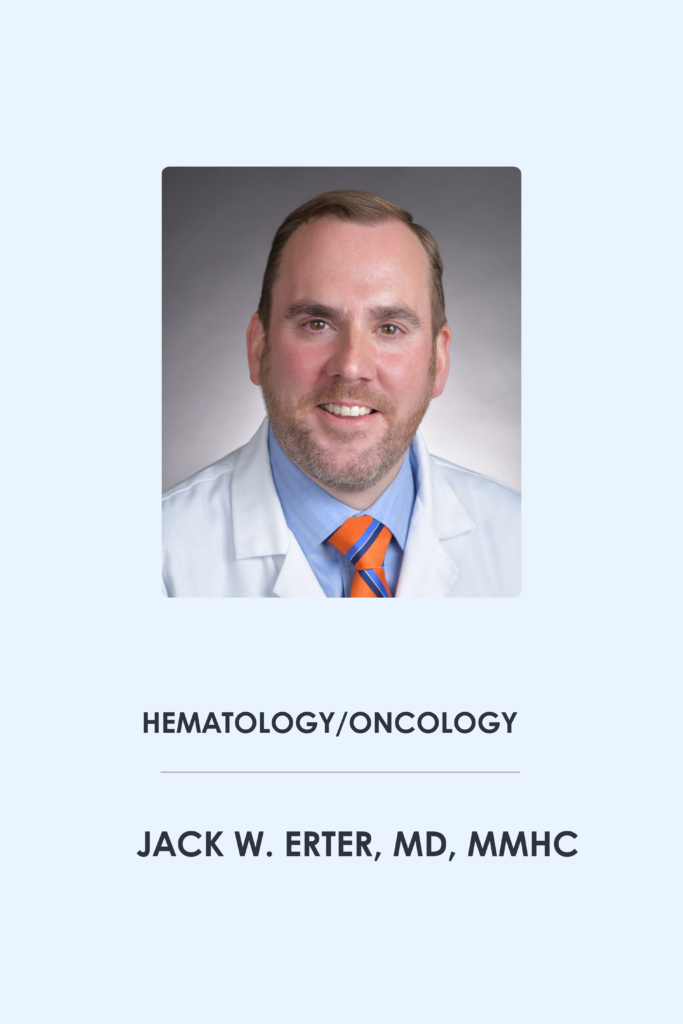
Dr. Jack W. Erter, MD, MMHC is triple board certified in Internal Medicine, Hematology, and Oncology. He earned his medical degree from the Medical University of South Carolina, completed his internal medicine internship and residency at Vanderbilt University, and completed his hematology/oncology fellowship at The Ohio State University. He is a partner at Tennessee Oncology, PLLC in Nashville, one of the nation’s largest private hematology/oncology groups. Dr. Erter has been involved in expert witness work for more than a decade, offering his expertise in a wide variety of medical-legal cases.
Contact Dr. Erter:
Email: [email protected]
Direct: (615) 934-7330
Disclaimer: The views and opinions expressed in this article are those of the author and do not necessarily reflect those of High Rock Experts®. This content is for educational and informational purposes only and does not constitute medical or legal advice.
About High Rock Experts®
Trusted Medical Experts for Attorneys. Training Clinicians Attorneys Actually Hire.
Founded by Amy G. Fogelman, MD, High Rock Experts® has matched more than 800 medical experts with attorneys nationwide since 2018. Through High Rock® Academy, Dr. Fogelman trains clinicians to become medical experts attorneys actually hire.