

July 2020
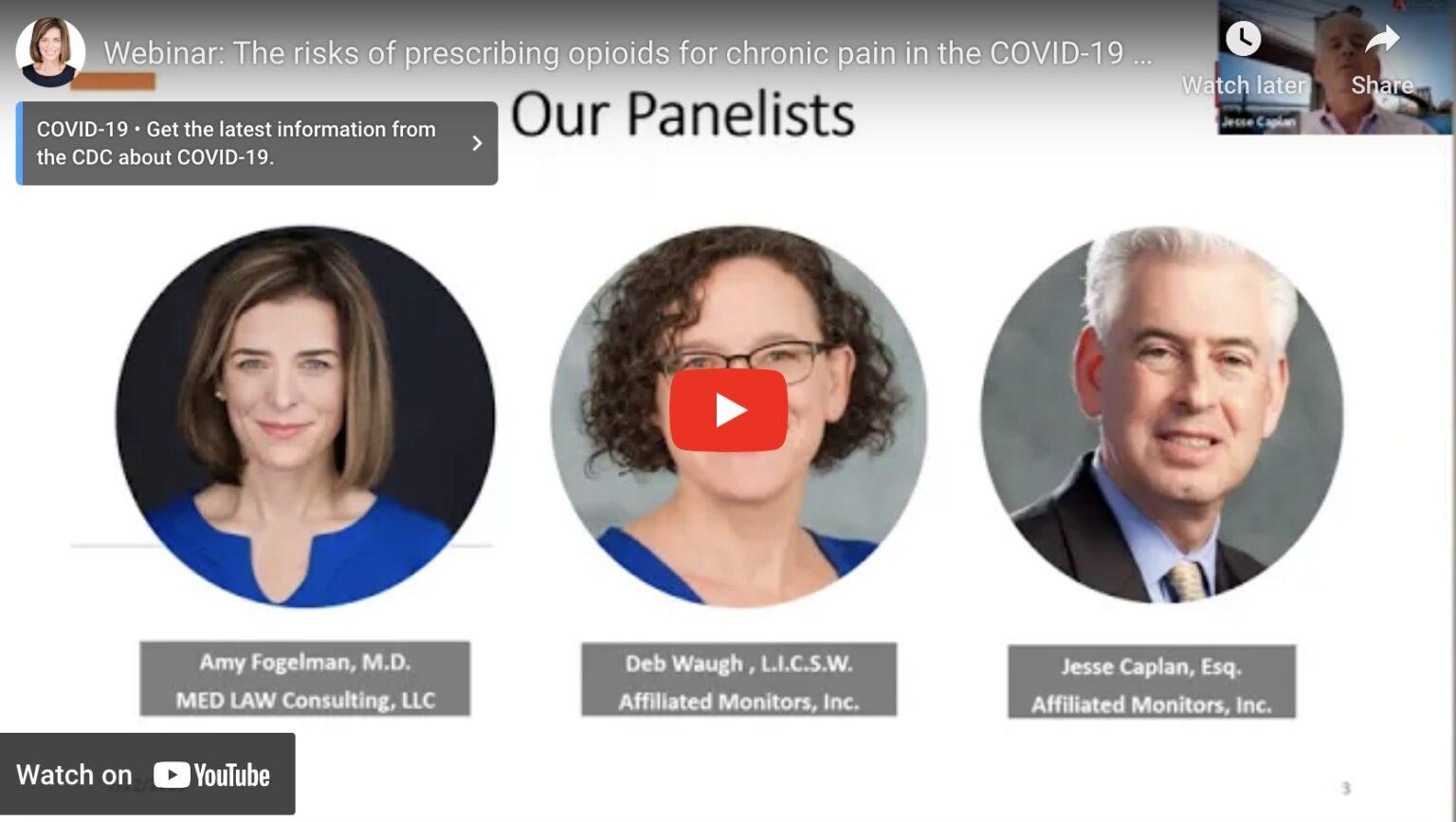
This week I joined Jesse Caplan and Deb Waugh of Affiliated Monitors for a webinar on navigating the risks of prescribing opioids for chronic pain during the COVID-19 pandemic.
The format was three perspectives on one problem. Jesse brought the legal and regulatory view as an attorney who has represented healthcare organizations and regulatory agencies. Deb brought the assessment view as a licensed clinical social worker who has designed and conducted hundreds of physician competency evaluations. I brought the clinical view, based on reviewing the opioid prescribing practices of a lot of physicians, NPs, and PAs and identifying where the standard of care broke down.
Here is what I shared, and what I am seeing right now in practice.
Start here: the new pandemic pain guidelines
Before anything else, a group of prominent pain physicians from multiple specialties published best practice guidance this month in Pain Medicine on pain management during the pandemic. It is also available online.
If you prescribe for chronic pain and have not read it, do that first. We could fill an entire webinar discussing it. The sections on managing opioids are especially relevant to everything below.
The trustworthy trap
Before the webinar I asked a group of colleagues a simple question. How is opioid prescribing going for you right now?
The answer I heard repeatedly was some version of this: it is going fine, because I trust my patients.
I call that the trustworthy trap.
Anyone can become addicted to opioids. It has nothing to do with whether their physician trusts them. Opioid use disorder is a known side effect of the medication. It is not a character flaw a good clinician can spot across an exam room.
When a physician believes their own patients are the exception, they become complacent about the one risk they are supposed to be watching for. This was a problem before the pandemic. Right now, with everyone stretched thin, I think it is getting worse.
The autopilot problem
The second pattern I see constantly is what I call the autopilot problem.
An opioid gets started by one clinician, often years ago, often before our current understanding of the risks. Then it gets renewed. And renewed again. Each clinician who inherits the patient continues what the last one did, and nobody stops to ask the original question.
The tell is usually the diagnosis field. Very often it simply reads chronic pain.
That is not a diagnosis that supports a high risk treatment. Gout is chronic pain. Chronic migraine is chronic pain. Neither one warrants opioids, and the treatments are nothing alike. Sometimes the documented condition is one where opioids are not recommended at all, such as fibromyalgia.
The fix is not complicated. Stop and reassess. Have a visit with the patient specifically about this. Why are they on this medication? What did the original workup show? Is there something safer and more effective available now?
Often there is. If the opioid was started ten years ago, the treatment landscape for that condition has probably changed. Regular review belongs in every chronic pain patient’s care plan.
What the pandemic has taken away
Treating chronic pain is challenging in the best of times. The pandemic has created real challenges, and also some genuine opportunities.
The challenges first.
We have fewer objective findings, because we are relying on telehealth. A video exam is limited by design. You see only what the patient shows you. You cannot evaluate pupils well. You cannot smell the patient. You can attempt some maneuvers, but it takes creativity and it is not the same.
Toxicology screens are harder. You should still be getting them. But if your local case counts are high, you may reasonably judge that sending a patient to the lab carries more risk than the result is worth. Pill counts are close to impossible in a virtual environment.
Beyond the clinical, patients are losing employer sponsored insurance. And access to telehealth is not evenly distributed. Older patients may not be comfortable with a video visit. Patients without reliable internet cannot participate at all. These are complicated patients to begin with, and the pandemic is widening gaps that already existed.
What it has given us
There are real opportunities here too.
Some patients find it easier to check in virtually than to travel for an in person visit. For those patients, compliance is actually better right now. Visits have more usable time in them, because there is less wasted time, and the physician is not running behind because three patients hit traffic. Any practicing clinician knows exactly what I mean.
The DEA has also relaxed several rules during the public health emergency. The early changes matter:
- March 16: registered practitioners may use telehealth for controlled substance prescriptions during the pandemic.
- March 25: registrants may prescribe across state lines. This helps enormously if your patient lives in a different state than where you practice.
- March 28: exceptions to paper delivery requirements for emergency oral Schedule II prescriptions.
- March 31: authorized prescribers may provide buprenorphine to new and existing patients with opioid use disorder by telephone.
That last one is a genuine boon for opioid use disorder treatment. One caveat on all of it: check your state laws, because individual state requirements vary and may be more restrictive.
The combinations that raise the risk
Opioids alone carry a risk of respiratory depression. Certain additions raise it.
Benzodiazepines are the combination I see most. Concurrent prescribing increases overdose risk and all cause mortality, and it should be avoided whenever possible. There are usually better options. If the benzodiazepine is treating anxiety, has anyone considered talk therapy, or an SSRI like sertraline that addresses the underlying cause? That requires a slow taper and a real partnership with the patient. It works. I have had patients thank me once they were finally off alprazolam, because their anxiety was better controlled than it had been in years.
Other sedative hypnotics carry similar concerns, as do muscle relaxants. Recent studies on gabapentin and pregabalin show increased sedation and mortality risk.
Some combinations create a different kind of risk. A patient on an opioid is more tired and may be at higher risk of falls. Add a blood thinner and you have added a serious hemorrhage risk. Sometimes there is no better option for that patient. But they should be told. When I review charts, that conversation is frequently nowhere in the record. A good informed consent document should cover it.
Toxicology screens nobody reads
Toxicology screens are one of the few objective pieces of evidence we have in chronic pain management. There is not much else.
I see two failures. Either the clinician does not check the screen, or the clinician checks it and never interprets it. The second is more common than you would expect. The screen gets ordered, the box gets ticked, and nobody reads the result. You would never send a CBC and ignore what came back. This should be no different.
Two results deserve particular attention.
Something unexpected is present. An illicit substance, or a prescription you did not write. Either the patient is obtaining it outside the system, or there is another prescriber you do not know about. Neither situation should be ignored. Screen for substance use disorder and refer if indicated. If there is a second prescriber, call them, and consider whether opioids remain appropriate at all given the combination.
The prescribed medication is absent. The screen comes back clean, and nobody notices the oxycodone you are prescribing is not in it. Dose and frequency can account for some of this, and a toxicologist is worth consulting. But if the medication should have been detected and was not, the patient is likely doing something else with it. At that point you stop prescribing and follow a diversion protocol.
Following best practice guidelines means checking the screen. It also means interpreting it, every single time.
Naloxone
The CDC recommends naloxone for certain risk factors and when morphine equivalents are high. I recommend it with every opioid prescription.
There should be no stigma attached to it. What if a pet gets into the bottle? A grandchild? A guest in the home? It is a seat belt. It is there when you need it, and if you never need it, it harms no one.
The pandemic complicates this, because some people are isolated and there is nobody present to administer it. That is a real limitation. It is not a reason to skip the prescription.
Evidence of misuse already in the chart
This is the most concerning pattern, and the hardest to write about, because the clinicians involved are almost always well meaning and doing their best.
A patient on high dose opioids is admitted and intubated for respiratory depression. No cause is ever identified. That should raise suspicion of overdose, and it should change the plan going forward.
Less dramatic and far more common: frequent early refills. The medication went down the sink. The dog ate it. Someone stole it. Each story is plausible on its own. Believed every time, they add up to stockpiling.
Frequent dose escalation is the same kind of signal. It may mean the underlying pain condition is worsening. It may mean opioid use disorder has developed.
I want to be clear about this. There is nothing shameful about that outcome. Opioid use disorder is a known side effect of opioid therapy, chronic or even acute. Effective treatment exists. There is no reason a referral for specialized treatment should carry stigma, and every reason it should happen promptly when the side effect appears.
Where this is heading
Jesse closed the webinar with a question about what happens to the opioid epidemic after the immediate COVID crisis passes. Health Affairs published a piece in April predicting the epidemic will rage once the pandemic recedes, and reports point to a surge in prescriptions during this period.
My honest answer is that it concerns me.
Alcohol sales are up. Overdoses are up in many states. Addiction risk climbs with social isolation, with anxiety and depression, with the loss of normal coping, with boredom. And as I said above, naloxone does not help someone who is alone. A person quarantining by themselves who overdoses may die alone.
The loosening of DEA restrictions to allow virtual treatment for opioid use disorder is a real and good start. But many addiction treatment centers are closing right now because they are not being funded. That is the part that worries me most.
What to do this week
- Pick your highest risk patients and reassess the diagnosis. If the chart says chronic pain, that is your starting point.
- Look at every chart where an opioid sits alongside a benzodiazepine, a sedative hypnotic, a gabapentinoid, or an anticoagulant. Decide whether that combination is still justified, and document the conversation.
- Read every toxicology screen you order. Set a workflow that makes it impossible to skip.
- Add naloxone to your standard opioid prescription.
- Ask your patients directly how they are coping. Employment, insurance, losses in the family, alcohol use. The answers change your risk assessment.
None of this is exotic medicine. It is careful medicine, under conditions that make careful medicine harder than usual. That is exactly why it deserves deliberate attention right now.
About Dr. Amy Fogelman
Amy G. Fogelman, MD trains clinicians to become medical experts attorneys actually hire.
She is the founder of High Rock Experts® and High Rock® Academy. Since 2018, Dr. Fogelman has matched more than 800 medical experts with attorneys nationwide and trained more than 200 clinicians in expert witness work.
Through High Rock® Academy, she teaches clinicians how to evaluate cases, communicate with attorneys, write clear and defensible opinions, establish professional boundaries, and build the skills and credibility attorneys expect from medical experts.
Updated August 2026 to reflect the company’s current name and services